On August 23, the 2026 Annual Symposium of the Chinese Input-Output Association (CIOA) was held in Beijing. Hosted by the CIOA and organized by the School of Applied Economics and its affiliated research institutes at the University of Chinese Academy of Social Sciences (UCASS), the symposium centered on two core themes: "Input-Output and Global Value Chain Restructuring" and "Input-Output and High-Quality Economic Development." It brought together experts and scholars in economic accounting, industrial economics, and macroeconomic research to conduct systematic academic discussions on theoretical innovation, methodological optimization, and practical application of input-output analysis.
Lin Tao, Deputy Commissioner of the National Bureau of Statistics (NBS), and Xu Jincheng, Secretary of the CPC Committee of UCASS, attended the opening ceremony and delivered remarks. Zheng Xuegong, Director-general of the Department of National Accounts of the NBS and President of the CIOA, presided over the opening ceremony. Lin Tao noted that the new round of scientific and technological revolution and industrial transformation is profoundly reshaping the way we produce and live, and that how to employ input-output techniques to reflect the transition from old to new growth drivers and support the expansion of domestic demand and the optimization of supply has become an important research issue. He called on experts and scholars to conduct in-depth research, offer policy recommendations, and give full play to the role of think tanks in providing solid theoretical support and decision-making references for high-quality economic development. Xu Jincheng remarked that input-output accounting and analysis holds an important position in national economic governance and serves as a vital quantitative tool for national governance. He stressed the need to deepen theoretical research and practical application of input-output analysis and to promote its positive role in building China's independent knowledge system in economics. He expressed the hope that experts and scholars would engage in thorough exchanges and contribute their wisdom to advancing China's input-output accounting and serving high-quality economic development.
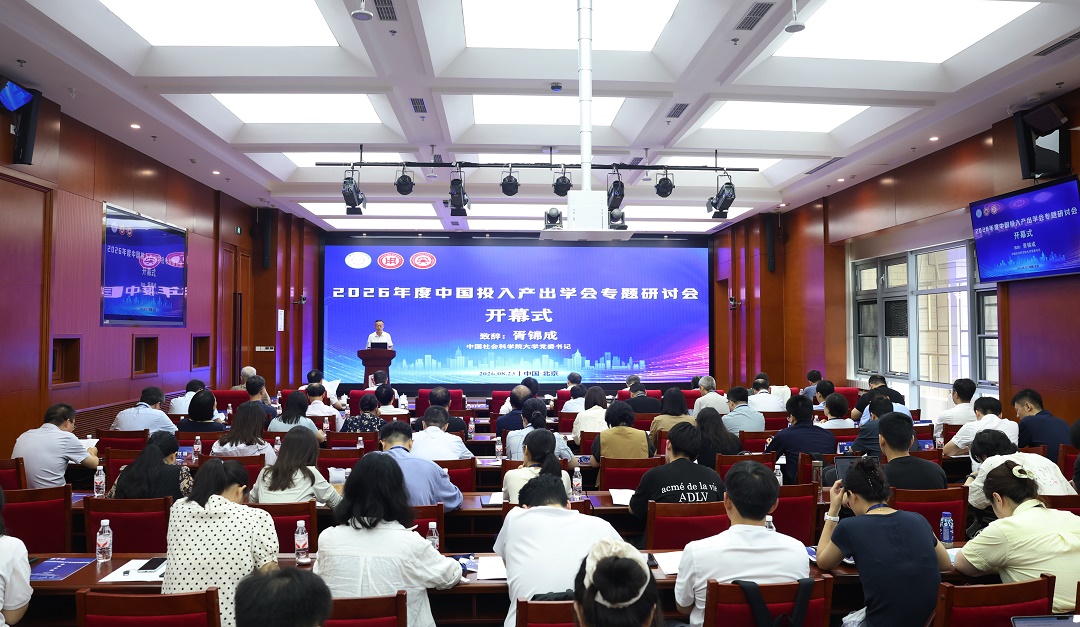
Xu Jincheng, Secretary of the CPC Committee of UCASS, delivers remarks at the opening ceremony of the 2026 Annual Symposium of the Chinese Input-Output Association, Aug. 23, 2026
The keynote session focused on cutting-edge issues of current economic development and elaborated on key areas including China’s economic structural transformation, optimization of domestic and international dual circulation, restructuring of global value chains, measurement of the AI-enabled economy, industrial chain security and development of green trade. Drawing on the input-output analytical paradigm, participating experts shared cutting-edge research findings on key issues such as upgrading of disciplinary methodology in the new era, innovation in empirical applications, and measurement of the digital economy. They broke through the limitations of traditional research and offered new ideas and avenues to align the input-output discipline with the needs of the new round of scientific and technological revolution and industrial transformation. Industry experts and academic leaders delivered professional commentary on a set of research findings, further distilling the academic value and research directions of the symposium.
The symposium also held a roundtable for academic journals, bringing together representatives from 13 core journals including Management World. Participants exchanged ideas on academic innovation within the input-output discipline, paper publishing, discipline development and talent cultivation, helping foster a high-quality platform for academic exchange and dissemination of research outputs. By pooling research strengths from leading domestic research institutions and universities, the symposium boosted academic exchange, theoretical iteration and practical application in input-output studies, laying a solid academic foundation to support China’s high-quality economic development.


